
Moana Ora Sanctuary Pathway Poster in English
The Humpback Whale — Tohora
A symbol of long-distance migration, the humpback whale connects Antarctica to our tropical lagoons. Each year, its presence reminds us that the ocean is a living network where reproduction, rest, songs, and great journeys all come together. The humpback whale is a marine mammal belonging to the group of cetaceans. It is a baleen whale, also known as a mysticete.
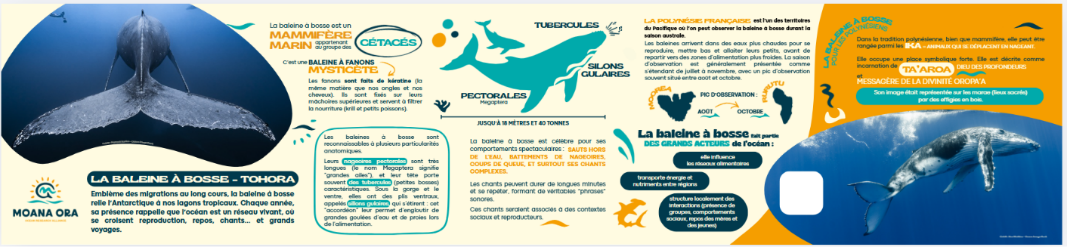
Baleen plates are made of keratin — the same material found in our nails and hair. Attached to the upper jaw, they are used to filter food such as krill and small fish. Humpback whales can be recognized by several distinctive anatomical features. Their pectoral fins are very long — the name Megaptera means "great wings" — and their heads are often covered with characteristic tubercles, or small bumps. Beneath the throat and belly, they have ventral pleats, known as gular grooves, which expand like an accordion. This allows them to engulf large volumes of water and prey while feeding.
Pectoral fins · Megaptera · Tubercles · Gular grooves · Up to 18 metres and 40 tons
The humpback whale is famous for its spectacular behaviors: breaching, fin slapping, tail slapping, and above all, its complex songs. Only males sing. These songs can last for several minutes and be repeated, forming true sound "phrases." These songs are thought to be associated with social and reproductive contexts.
French Polynesia is one of the Pacific territories where humpback whales can be observed during the austral season. Whales come to these warmer waters to reproduce, give birth, and nurse their calves before returning to colder feeding grounds. The whale-watching season is generally considered to run from July to November, with sightings often peaking between August and October.
Observation peak — August to October
The humpback whale is one of the great actors of the ocean: it influences food webs. It transports energy and nutrients between regions. It locally shapes interactions through the presence of groups, social behaviors, and resting areas for mothers and calves.
The Humpback Whale in Polynesian Culture
In Polynesian tradition, although it is a mammal, the whale may be classified among the IKA, animals that move by swimming.
It holds a strong symbolic place. It is described as an incarnation of Ta'aroa, god of the depths, and as a messenger of the divinity Ora'a. Its image was represented on marae, sacred places, through wooden effigies.
Moana Ora Sanctuary Pathway Poster in English
The Humpback Whale — Tohora
A symbol of long-distance migration, the humpback whale connects Antarctica to our tropical lagoons. Each year, its presence reminds us that the ocean is a living network where reproduction, rest, songs, and great journeys all come together. The humpback whale is a marine mammal belonging to the group of cetaceans. It is a baleen whale, also known as a mysticete.
Baleen plates are made of keratin — the same material found in our nails and hair. Attached to the upper jaw, they are used to filter food such as krill and small fish. Humpback whales can be recognized by several distinctive anatomical features. Their pectoral fins are very long — the name Megaptera means "great wings" — and their heads are often covered with characteristic tubercles, or small bumps. Beneath the throat and belly, they have ventral pleats, known as gular grooves, which expand like an accordion. This allows them to engulf large volumes of water and prey while feeding.
Pectoral fins · Megaptera · Tubercles · Gular grooves · Up to 18 metres and 40 tons
The humpback whale is famous for its spectacular behaviors: breaching, fin slapping, tail slapping, and above all, its complex songs. Only males sing. These songs can last for several minutes and be repeated, forming true sound "phrases." These songs are thought to be associated with social and reproductive contexts.
French Polynesia is one of the Pacific territories where humpback whales can be observed during the austral season. Whales come to these warmer waters to reproduce, give birth, and nurse their calves before returning to colder feeding grounds. The whale-watching season is generally considered to run from July to November, with sightings often peaking between August and October.
Observation peak — August to October
The humpback whale is one of the great actors of the ocean: it influences food webs. It transports energy and nutrients between regions. It locally shapes interactions through the presence of groups, social behaviors, and resting areas for mothers and calves.
The Humpback Whale in Polynesian Culture
In Polynesian tradition, although it is a mammal, the whale may be classified among the IKA, animals that move by swimming.
It holds a strong symbolic place. It is described as an incarnation of Ta'aroa, god of the depths, and as a messenger of the divinity Ora'a. Its image was represented on marae, sacred places, through wooden effigies.