
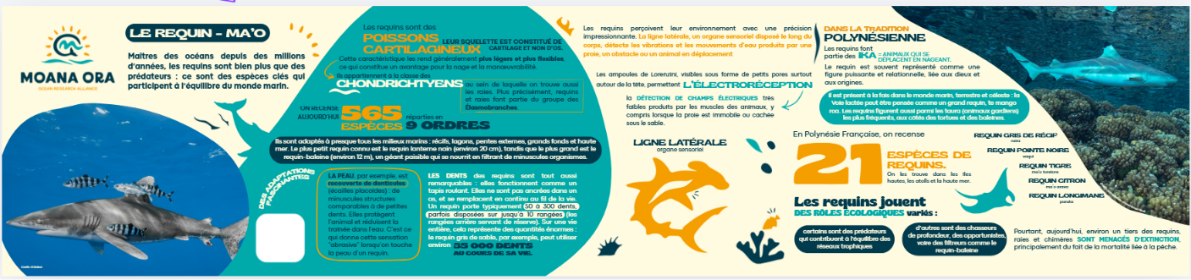
Moana Ora Sanctuary Pathway Poster in English
The Shark — Te Ma'o
Masters of the oceans for millions of years
Sharks are far more than predators: they are key species that contribute to the balance of the marine world. Sharks are cartilaginous fish. Their skeleton is made of cartilage, not bone. This makes them generally lighter and more flexible, which is an advantage for swimming and maneuverability.
They belong to the class of chondrichthyans, which also includes rays. More precisely, sharks and rays are part of the group known as elasmobranchs. Today, 565 species are recorded, distributed across 9 orders. Sharks are adapted to almost every marine environment: reefs, lagoons, outer slopes, deep waters, and the open ocean. The smallest known shark is the dwarf lanternshark, around 20 cm long, while the largest is the whale shark, around 12 m long: a peaceful giant that feeds by filtering tiny organisms. Their skin is covered with denticles, microscopic tooth-like scales that form a structure comparable to tiny teeth. They protect the animal and reduce drag in the water. This is why the skin feels "soft" in one direction and "rough" in the other.
Sharks' teeth are also remarkable. They are continuously renewed throughout life and are not rooted in bone. A shark may have 50 to 300 teeth, sometimes arranged in up to 10 rows: a true "reserve conveyor belt." Over an entire lifetime, some sharks may use around 30,000 teeth.
Sharks perceive their environment with remarkable precision. The lateral line, a sensory organ located along the body, detects vibrations and water movements produced by prey, obstacles, or moving animals. The ampullae of Lorenzini, visible as small pores mostly around the head, allow sharks to sense electric fields that are too weak for most animals to detect, including when prey is motionless or hidden under the sand.
Lateral line — sensory organ
In Polynesian Tradition
The shark belongs to the IKA, animals that swim and move through the water. It is often represented as a relational figure, connected to the gods and to origins. It is present in the marine, terrestrial, and celestial worlds. The Milky Way itself can be imagined as a great "mango roa," the great shark moving through the sky. The stars most frequently associated with the shark are Taua, the shark's eye, alongside turtles and whales.
In French Polynesia, there are 21 shark species. They are found around the islands, atolls, and offshore:
- Reef shark — ma'o raira
- Blacktip shark — ma'o mauri
- Tiger shark — ma'o tore tore
- Lemon shark — ma'o arava
- Longimanus shark — parata
Sharks play a variety of ecological roles. Some are predators that help maintain the balance of food webs. Others are opportunistic feeders, or filter feeders like the whale shark. Today, around one third of shark, ray, and chimaera species are threatened with extinction, mainly due to fishing-related mortality.
Moana Ora Sanctuary Pathway Poster in English
The Shark — Te Ma'o
Masters of the oceans for millions of years
Sharks are far more than predators: they are key species that contribute to the balance of the marine world. Sharks are cartilaginous fish. Their skeleton is made of cartilage, not bone. This makes them generally lighter and more flexible, which is an advantage for swimming and maneuverability.
They belong to the class of chondrichthyans, which also includes rays. More precisely, sharks and rays are part of the group known as elasmobranchs. Today, 565 species are recorded, distributed across 9 orders. Sharks are adapted to almost every marine environment: reefs, lagoons, outer slopes, deep waters, and the open ocean. The smallest known shark is the dwarf lanternshark, around 20 cm long, while the largest is the whale shark, around 12 m long: a peaceful giant that feeds by filtering tiny organisms. Their skin is covered with denticles, microscopic tooth-like scales that form a structure comparable to tiny teeth. They protect the animal and reduce drag in the water. This is why the skin feels "soft" in one direction and "rough" in the other.
Sharks' teeth are also remarkable. They are continuously renewed throughout life and are not rooted in bone. A shark may have 50 to 300 teeth, sometimes arranged in up to 10 rows: a true "reserve conveyor belt." Over an entire lifetime, some sharks may use around 30,000 teeth.
Sharks perceive their environment with remarkable precision. The lateral line, a sensory organ located along the body, detects vibrations and water movements produced by prey, obstacles, or moving animals. The ampullae of Lorenzini, visible as small pores mostly around the head, allow sharks to sense electric fields that are too weak for most animals to detect, including when prey is motionless or hidden under the sand.
Lateral line — sensory organ
In Polynesian Tradition
The shark belongs to the IKA, animals that swim and move through the water. It is often represented as a relational figure, connected to the gods and to origins. It is present in the marine, terrestrial, and celestial worlds. The Milky Way itself can be imagined as a great "mango roa," the great shark moving through the sky. The stars most frequently associated with the shark are Taua, the shark's eye, alongside turtles and whales.
In French Polynesia, there are 21 shark species. They are found around the islands, atolls, and offshore:
- Reef shark — ma'o raira
- Blacktip shark — ma'o mauri
- Tiger shark — ma'o tore tore
- Lemon shark — ma'o arava
- Longimanus shark — parata
Sharks play a variety of ecological roles. Some are predators that help maintain the balance of food webs. Others are opportunistic feeders, or filter feeders like the whale shark. Today, around one third of shark, ray, and chimaera species are threatened with extinction, mainly due to fishing-related mortality.