Moana Ora Sanctuary Pathway Poster in English
The Turtle — Te Honu
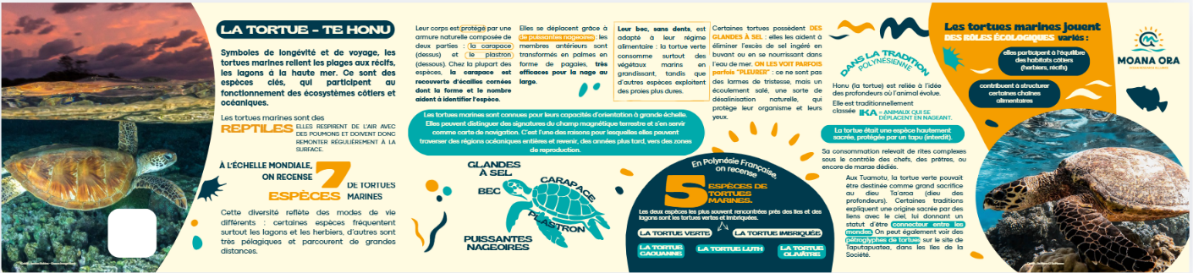
Symbols of longevity and voyaging, sea turtles connect beaches to reefs, and lagoons to the open ocean. They are key species that contribute to the functioning of coastal and oceanic ecosystems. Sea turtles are reptiles. They breathe air with lungs and must therefore regularly return to the surface.
Worldwide, there are currently 7 species of sea turtles. This diversity reflects different lifestyles: some species mainly frequent lagoons and seagrass beds, while others are highly pelagic and travel great distances. Their body is protected by a natural shell composed of two parts: the carapace above and the plastron below. In most species, the carapace is covered with horny scutes whose number and shape help identify the species.
Sea turtles are known for their remarkable long-distance orientation abilities. They can recognize signatures in the Earth's magnetic field and use them like a navigation map. This is one reason why they can cross entire ocean regions and return, years later, to their nesting beaches. They move using powerful flippers. The forelimbs have evolved into highly efficient paddles for swimming over long distances. Their toothless beak is adapted to their diet. Green turtles mainly graze on marine plants as they grow older, while other species feed on harder prey.
Some turtles have salt glands. These help them eliminate excess salt absorbed while living in seawater.
This is why they are sometimes seen "crying": these are not tears of sadness, but a salt-excretion mechanism — a natural form of desalination that protects their body and eyes.
Carapace · Plastron · Beak · Powerful flippers · Salt glands
In French Polynesia, there are 5 species of sea turtles. The two species most often encountered near the islands and lagoons are the green turtle and the hawksbill. Also present: the loggerhead, the leatherback, and the olive ridley turtle.
In Polynesian Tradition
Honu, the turtle, is associated with the idea of depth, the original world, and life. It is traditionally classified among the IKA, animals that move by swimming. The turtle was considered sacred and protected by tapu. Its consumption was governed by complex rituals, under the authority of chiefs, priests, or during special occasions. In the Tuamotu, the green turtle could be understood as a sacred figure associated with the god Ta'aroa, god of the depths. Some traditions explain its sacred origin through a link with the sky, giving it the role of connector between worlds. The turtle can also be seen as a petroglyph on the stones of Taputapuatea, in the Society Islands.
Sea turtles play a variety of ecological roles. They contribute to the balance of coastal habitats, especially seagrass beds, and help structure certain food chains.
Moana Ora Sanctuary Pathway Poster in English
The Turtle — Te Honu
Symbols of longevity and voyaging, sea turtles connect beaches to reefs, and lagoons to the open ocean. They are key species that contribute to the functioning of coastal and oceanic ecosystems. Sea turtles are reptiles. They breathe air with lungs and must therefore regularly return to the surface.
Worldwide, there are currently 7 species of sea turtles. This diversity reflects different lifestyles: some species mainly frequent lagoons and seagrass beds, while others are highly pelagic and travel great distances. Their body is protected by a natural shell composed of two parts: the carapace above and the plastron below. In most species, the carapace is covered with horny scutes whose number and shape help identify the species.
Sea turtles are known for their remarkable long-distance orientation abilities. They can recognize signatures in the Earth's magnetic field and use them like a navigation map. This is one reason why they can cross entire ocean regions and return, years later, to their nesting beaches. They move using powerful flippers. The forelimbs have evolved into highly efficient paddles for swimming over long distances. Their toothless beak is adapted to their diet. Green turtles mainly graze on marine plants as they grow older, while other species feed on harder prey.
Some turtles have salt glands. These help them eliminate excess salt absorbed while living in seawater.
This is why they are sometimes seen "crying": these are not tears of sadness, but a salt-excretion mechanism — a natural form of desalination that protects their body and eyes.
Carapace · Plastron · Beak · Powerful flippers · Salt glands
In French Polynesia, there are 5 species of sea turtles. The two species most often encountered near the islands and lagoons are the green turtle and the hawksbill. Also present: the loggerhead, the leatherback, and the olive ridley turtle.
In Polynesian Tradition
Honu, the turtle, is associated with the idea of depth, the original world, and life. It is traditionally classified among the IKA, animals that move by swimming. The turtle was considered sacred and protected by tapu. Its consumption was governed by complex rituals, under the authority of chiefs, priests, or during special occasions. In the Tuamotu, the green turtle could be understood as a sacred figure associated with the god Ta'aroa, god of the depths. Some traditions explain its sacred origin through a link with the sky, giving it the role of connector between worlds. The turtle can also be seen as a petroglyph on the stones of Taputapuatea, in the Society Islands.
Sea turtles play a variety of ecological roles. They contribute to the balance of coastal habitats, especially seagrass beds, and help structure certain food chains.