
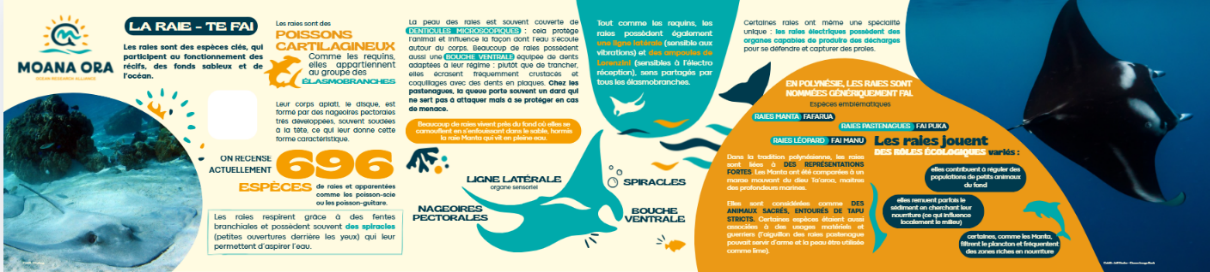
Moana Ora Sanctuary Pathway Poster in English
The Ray — Te Fai / Fafarua / Fai Manu
Rays are key species that contribute to the functioning of reefs, sandy bottoms, and the ocean. Rays are cartilaginous fish, like sharks. They belong to the group of elasmobranchs. Their flattened body, known as the disc, is formed by highly developed pectoral fins, often fused to the head, giving them their distinctive shape.
There are currently 696 recorded species of rays and related species, such as sawfish and guitarfish. Rays breathe through gill slits and often have spiracles (small openings behind the eyes) that allow them to draw in water. The skin of rays is often covered with microscopic denticles. This surface affects how water flows around the body. Many rays also have ventral mouths, equipped with teeth adapted to their diet. Rather than cutting, they often crush crustaceans and shellfish with plate-like teeth.
In stingrays, the tail often bears a barb. It is not used to attack, but to defend the animal in case of threat.
Many rays live close to the seafloor, where they camouflage themselves by burying themselves in the sand. Manta rays are an exception, as they live in open water. Like sharks, rays have a lateral line, sensitive to vibrations, and ampullae of Lorenzini, sensitive to electric fields. These senses are shared by all elasmobranchs. Some rays have a unique specialization: electric rays possess organs capable of producing electric discharges to defend themselves and capture prey.
Lateral line sensory organ · Spiracles · Ventral mouth · Pectoral fins
In Polynesia, rays are generally called fai — emblematic species: manta rays — fafarua, stingrays — fai puka, leopard rays — fai manu.
In Polynesian tradition, rays are associated with powerful representations. Manta rays have been compared to a moving marae of the god Ta'aroa, master of the marine depths. They are considered sacred animals, surrounded by strict tapu.
Some species were also associated with practical and warrior uses: the stingray barb could be used as a weapon, and the skin could be used as a file.
Rays play a variety of ecological roles. They help regulate populations of small animals living on the seafloor. They sometimes stir up sediment while searching for food, locally influencing the environment. Some species, such as manta rays, filter plankton and frequent nutrient-rich areas.
Moana Ora Sanctuary Pathway Poster in English
The Ray — Te Fai / Fafarua / Fai Manu
Rays are key species that contribute to the functioning of reefs, sandy bottoms, and the ocean. Rays are cartilaginous fish, like sharks. They belong to the group of elasmobranchs. Their flattened body, known as the disc, is formed by highly developed pectoral fins, often fused to the head, giving them their distinctive shape.
There are currently 696 recorded species of rays and related species, such as sawfish and guitarfish. Rays breathe through gill slits and often have spiracles (small openings behind the eyes) that allow them to draw in water. The skin of rays is often covered with microscopic denticles. This surface affects how water flows around the body. Many rays also have ventral mouths, equipped with teeth adapted to their diet. Rather than cutting, they often crush crustaceans and shellfish with plate-like teeth.
In stingrays, the tail often bears a barb. It is not used to attack, but to defend the animal in case of threat.
Many rays live close to the seafloor, where they camouflage themselves by burying themselves in the sand. Manta rays are an exception, as they live in open water. Like sharks, rays have a lateral line, sensitive to vibrations, and ampullae of Lorenzini, sensitive to electric fields. These senses are shared by all elasmobranchs. Some rays have a unique specialization: electric rays possess organs capable of producing electric discharges to defend themselves and capture prey.
Lateral line sensory organ · Spiracles · Ventral mouth · Pectoral fins
In Polynesia, rays are generally called fai — emblematic species: manta rays — fafarua, stingrays — fai puka, leopard rays — fai manu.
In Polynesian tradition, rays are associated with powerful representations. Manta rays have been compared to a moving marae of the god Ta'aroa, master of the marine depths. They are considered sacred animals, surrounded by strict tapu.
Some species were also associated with practical and warrior uses: the stingray barb could be used as a weapon, and the skin could be used as a file.
Rays play a variety of ecological roles. They help regulate populations of small animals living on the seafloor. They sometimes stir up sediment while searching for food, locally influencing the environment. Some species, such as manta rays, filter plankton and frequent nutrient-rich areas.