
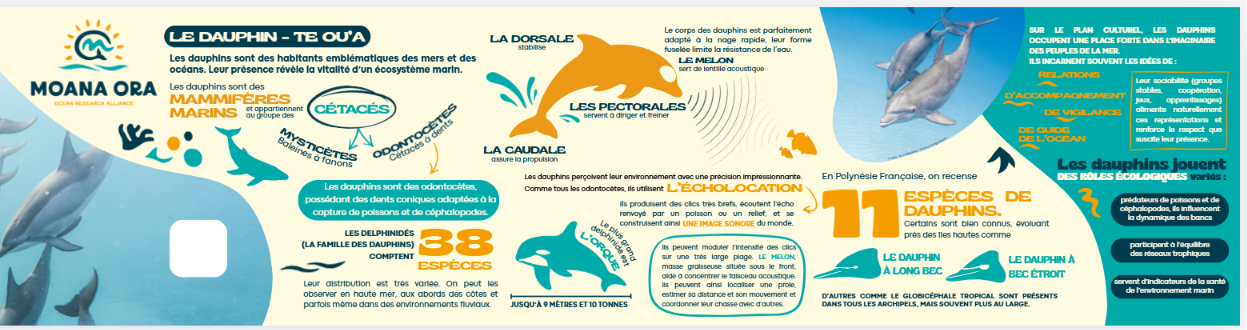
Moana Ora Sanctuary Pathway Poster in English
The Dolphin — Te Ou'a
Dolphins are iconic inhabitants of the seas and oceans. Their presence reflects the vitality of a marine ecosystem. Dolphins are marine mammals belonging to the group of cetaceans. They are odontocetes, or toothed cetaceans. They have cone-shaped teeth adapted for catching fish and cephalopods.
The Delphinidae, the dolphin family, includes 38 species. Their distribution is highly varied. They can be found offshore, along coastlines, and sometimes even in river environments.
The DORSAL FIN provides stability.
The CAUDAL FIN provides propulsion.
The PECTORAL FINS are used for steering and braking.
A dolphin's body is perfectly adapted for fast swimming, thanks to its streamlined shape.
The MELON is made of fatty tissue. Dolphins perceive their environment with remarkable precision. Like all odontocetes, they use echolocation. They produce very brief clicks, listen to the returning echoes, and process them through a sophisticated inner ear. They can modulate the intensity of their clicks over a very wide range. The melon, a fatty mass located on the forehead, helps focus the acoustic beam. They can therefore locate prey, estimate distance and movement, and coordinate hunting with other dolphins.
In French Polynesia, 11 dolphin species have been recorded. Some are well known and found around the high islands, such as: the long-beaked dolphin — the rough-toothed dolphin.
Other species, such as the short-finned pilot whale and the false killer whale, are found throughout the archipelagos, but more often offshore. Orca: up to 9 metres and 10 tons.
The Dolphin in Polynesian Culture
Dolphins hold an important place in the imagination of seafaring peoples. They often embody ideas of relationship, accompaniment, guidance, and ocean vigilance.
Their sociability, stable groups, cooperation, play, and learning naturally feed these representations and reinforce the respect inspired by their presence.
Dolphins play important ecological roles. As predators of fish and cephalopods, they influence prey dynamics, contribute to the balance of food webs, and serve as indicators of the health of the marine environment.
Moana Ora Sanctuary Pathway Poster in English
The Dolphin — Te Ou'a
Dolphins are iconic inhabitants of the seas and oceans. Their presence reflects the vitality of a marine ecosystem. Dolphins are marine mammals belonging to the group of cetaceans. They are odontocetes, or toothed cetaceans. They have cone-shaped teeth adapted for catching fish and cephalopods.
The Delphinidae, the dolphin family, includes 38 species. Their distribution is highly varied. They can be found offshore, along coastlines, and sometimes even in river environments.
The DORSAL FIN provides stability.
The CAUDAL FIN provides propulsion.
The PECTORAL FINS are used for steering and braking.
A dolphin's body is perfectly adapted for fast swimming, thanks to its streamlined shape.
The MELON is made of fatty tissue. Dolphins perceive their environment with remarkable precision. Like all odontocetes, they use echolocation. They produce very brief clicks, listen to the returning echoes, and process them through a sophisticated inner ear. They can modulate the intensity of their clicks over a very wide range. The melon, a fatty mass located on the forehead, helps focus the acoustic beam. They can therefore locate prey, estimate distance and movement, and coordinate hunting with other dolphins.
In French Polynesia, 11 dolphin species have been recorded. Some are well known and found around the high islands, such as: the long-beaked dolphin — the rough-toothed dolphin.
Other species, such as the short-finned pilot whale and the false killer whale, are found throughout the archipelagos, but more often offshore. Orca: up to 9 metres and 10 tons.
The Dolphin in Polynesian Culture
Dolphins hold an important place in the imagination of seafaring peoples. They often embody ideas of relationship, accompaniment, guidance, and ocean vigilance.
Their sociability, stable groups, cooperation, play, and learning naturally feed these representations and reinforce the respect inspired by their presence.
Dolphins play important ecological roles. As predators of fish and cephalopods, they influence prey dynamics, contribute to the balance of food webs, and serve as indicators of the health of the marine environment.